Las cartas anónimas de Pepito Méndez
Los renglones torcidos de DiosLas cartas anónimas de Pepito Méndez are a series of unsigned, unsettling letters whose importance lies less in any coherent message than in the trail they leave behind. A bizarre note found outside Alice Gould’s room links Pepito Méndez, known as el Albaricoque, to the weekly missives that Raimundo García del Olmo had asked Alice to investigate. The letters turn handwriting, paper, and the act of delivery into clues: their author is concealed, but the material evidence points back into the hospital and toward its offices.
The letter at Alice’s door
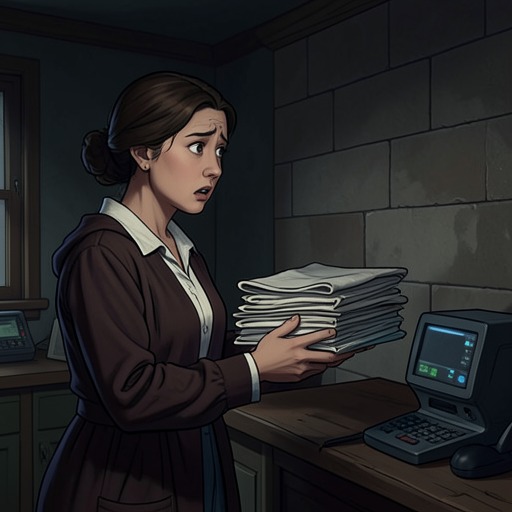
During a monotonous period of confinement, Alice finds a very long letter beside the threshold of her room. It may have been pushed beneath the door, though the means of delivery is only presumed. The note has no signature. Its arrival raises immediate questions for her: what it means, why it has been sent to her, and who brought it there. The letter’s placement makes it feel personal, but the uncertainty surrounding its sender and purpose prevents that first impression from settling into an answer.
The page is striking before its message can be deciphered. It has no commas, semicolons, full stops, or paragraph breaks, and no spaces between words. Its handwriting is mannered to an extreme and difficult to read. The writing itself is described as incoherent and extravagant, yet marked by occasional flashes of ingenious lucidity. It opens with a declaration about collective morality as an article and ends in an emphatic reference to hemorrhoids. Those fragments do not yield a stable explanation; instead, the letter’s abrupt shifts and disorder make interpretation part of the mystery.
Arellano identifies the addressee
Alice takes the letter to César Arellano and asks who wrote it and what it means. He first teases her by pretending it is a love letter, then makes clear that the joke is not serious: the note is addressed to him, not to Alice. He identifies its author and calls for Conrada Segunda, asking her to have Pepito Méndez brought to him. The summons gives Alice’s puzzling discovery a specific human connection, while overturning the apparent assumption that the letter was meant for its finder.
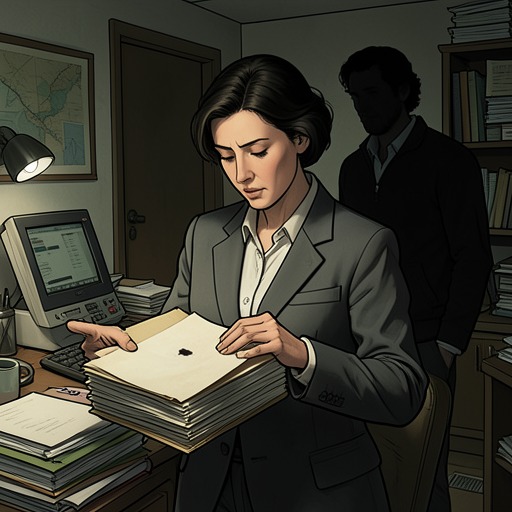
Before Pepito is brought in, Alice studies the handwriting again. The more she considers it, the more closely it resembles the writing on the letters Raimundo had received. That comparison matters because the note’s oddity is no longer merely a private curiosity at her door: it may be connected to the case that brought her into the hospital. Yet resemblance is initially a clue rather than a complete explanation. The unsigned page does not itself name its author or spell out its relationship to the earlier correspondence.
The connection to Raimundo’s letters
Alice’s later account supplies the investigative history behind the comparison. Raimundo had begun receiving weekly missives, and he commissioned her to discover where they came from. Her examination of the handwriting led her to conclude that the author was a psychotic person confined at the hospital. This finding gives the letters a concealed institutional source: what had arrived as anonymous correspondence from outside the recipient’s understanding was, in Alice’s reconstruction, being written by someone already inside the asylum.
The paper provides a second, distinct line of evidence. Alice determines that it is not the paper ordinarily supplied to patients, but paper used in the offices of Nuestra Señora de la Fuentecilla Psychiatric Hospital. More particularly, she recognizes it as the same kind of letter paper used by Arellano. The sheets had been cut with scissors along the top, removing the hospital’s name and address. That alteration both hides the origin and leaves a trace of concealment: the missing heading is not proof of an external source but part of the method by which institutional stationery could pass as anonymous correspondence.
Alice says that she confirmed her conclusions when she saw a letter imposing conditions on her entry into the hospital. The episode places the correspondence within the practical circumstances of her investigation and admission, rather than treating the handwriting analysis as an abstract suspicion. The physical letter she has brought to Arellano, her comparison with Raimundo’s weekly messages, and the office paper with its heading removed form related pieces of evidence, though the account does not make every step of their handling visible.
Anonymity as evidence
The letters work through a contrast between apparent unintelligibility and precise material clues. Their language seems to resist orderly reading: words run together, punctuation disappears, and flashes of lucidity sit beside extravagant incoherence. Their physical features, by contrast, can be compared. Handwriting links one message to another; the cut paper links the correspondence to hospital offices. What the text does not explain, its form and substrate allow Alice to investigate.
Anonymity is therefore not simply a blank where an author’s name should be. It is a condition the investigation gradually tests against resemblance, institutional access, and the altered stationery. The letter outside Alice’s room first misdirects her toward the question of why she herself has been addressed; Arellano’s correction redirects attention to the sender and the intended recipient, while her recognition of the handwriting carries the clue back to Raimundo’s case. In that movement, the letters become both evidence and an unresolved puzzle: enough is disclosed to identify Pepito as their author and locate their paper’s source, but the surviving account does not offer a coherent paraphrase of their message or a full explanation of every letter’s delivery.